Missed calls
What does a missed call cost a small business?
Work out what a missed call costs your business from your own job value, close rate, and callback rate, then compare what each of the fixes costs to run.
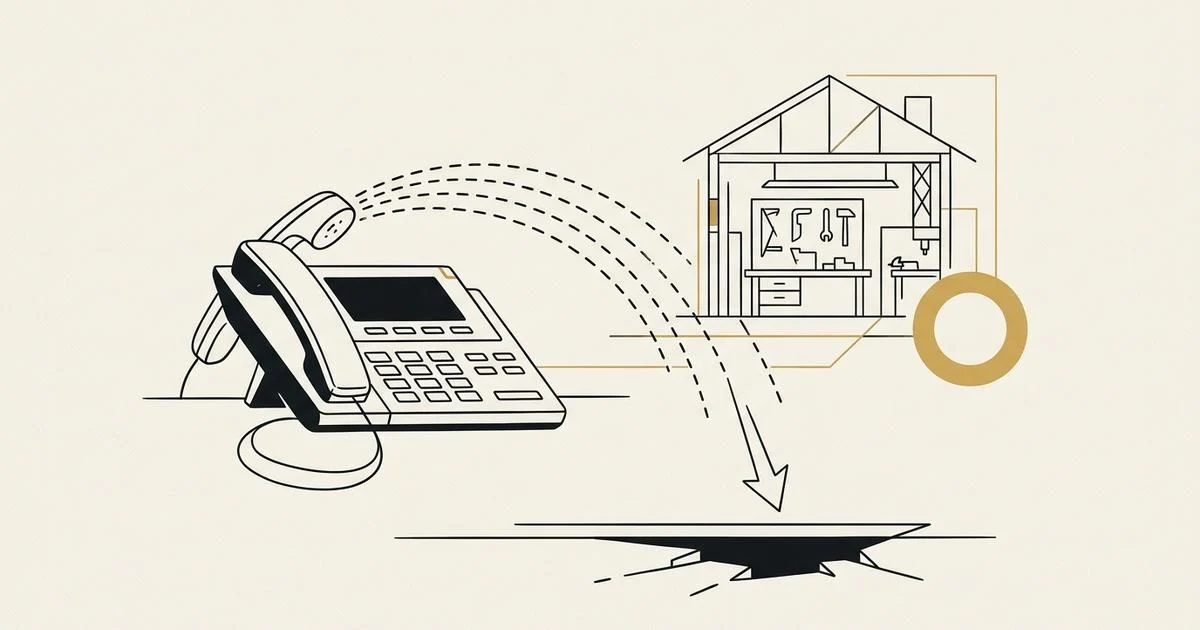
A missed call costs you one job's value times the odds that caller would have booked. Subtract whatever share of missed callers ring you back. For a plumber missing 6 calls a week on $450 CAD jobs, that is about $27,378 CAD a year.
That number is arithmetic, not a statistic. Every input belongs to your business. Measure them instead of borrowing a figure off a vendor's blog.
The short version
- The formula: missed calls a week, times the share who never call back, times your close rate, times your job value, times 52.
- 86% of consumers do not answer calls from numbers they do not recognize (Hiya State of the Call 2026, fielded December 2025 to January 2026). Calling back is not the same as answering.
- The worked example below lands at $27,378 CAD a year. That is 3.7% of what the average profitable Canadian plumbing and HVAC contractor books (ISED, 2024 data).
- A receptionist at the Canadian median of $21.00 CAD an hour costs more than that (Job Bank Canada, NOC 14101, November 2025).
- Ignore the six-figure loss figure that circulates in this category. It names no sample and no method.
The formula for what a missed call costs you
Annual loss = missed calls a week × (1 minus your callback rate) × your close rate × your average job value × 52.
Four numbers decide it, and you already have three of them. Multiply them out and you get a figure that belongs to your business rather than to an industry average.
| Input | What it means | Where to get it |
|---|---|---|
| Missed calls a week | Calls that ring out, hit voicemail, or get declined | Your phone's call log, one week, counted honestly |
| Callback rate | The share of missed numbers that ring you again within 48 hours | Cross-check last month's missed calls against your call log |
| Close rate | The share of answered inquiry calls that become paid jobs | Your invoices divided by your answered inquiry calls |
| Average job value | Total revenue divided by number of jobs | Last 12 months of invoices |
Worked example, using a residential plumber. Take 6 missed calls a week, a 35% callback rate, a 30% close rate, and a $450 CAD average job.
That is 3.9 callers a week gone for good and 1.17 lost jobs. It comes to $526.50 CAD a week, or $27,378 CAD a year.
What this model assumes. It treats every caller who rings back as fully recovered, which is generous. It also assumes 52 flat weeks with no season, and one job value with no repeat work behind it. Change any input and the answer moves a long way, which is exactly why a single national figure is useless here.
The formula does not care about currency. Run it in USD if you are in the United States, using your own local wage and job numbers.
Why calling back later is not the same as answering
Because the person you are calling back does not recognize your number. The callback is a second, weaker attempt at the same conversation.
86% of consumers do not answer calls from numbers they do not recognize, and only 14% answer immediately (Hiya State of the Call 2026, Censuswide survey of more than 12,000 consumers in Canada, the United States, and four European countries, fielded 17 December 2025 to 2 January 2026).
Read the top bar carefully. The largest group in that chart waits for a voicemail you never left, because you were calling back rather than being called.
One thing changes the odds. 29% of respondents named the single piece of information most likely to make them answer: a verified business name on the caller ID (Hiya State of the Call 2026, fielded December 2025 to January 2026).
What the loss looks like across a year
It adds up in a straight line, so the gap between job values widens every week. At 5 missed calls a week, a $250 CAD job loses $12,675 CAD by week 52. The same miss rate on a $1,200 CAD job loses $60,840 CAD.
Run the same model at three miss rates and the spread gets wider still. Every cell below holds the close rate at 30% and the callback rate at 35%. These are computed figures with every input printed on the page, which is the opposite of a borrowed industry average.
| Annual loss by job value | 2 missed calls a week | 5 a week | 8 a week |
|---|---|---|---|
| $250 CAD job | $5,070 CAD | $12,675 CAD | $20,280 CAD |
| $600 CAD job | $12,168 CAD | $30,420 CAD | $48,672 CAD |
| $1,200 CAD job | $24,336 CAD | $60,840 CAD | $97,344 CAD |
Miss rate and job value matter about equally. A high-ticket trade can therefore fix this profitably at a much lower call volume than a low-ticket one.
Scale matters too. The $97,344 CAD corner is roughly 13% of $747,000 CAD. That is the average annual revenue profitable Canadian plumbing, heating, and air-conditioning contractors reported (ISED Financial Performance Data, 2024 data).
Why it is almost always the owner missing the call
Because there is nobody else there. 59.1% of Canada's 1.10 million employer businesses have 1 to 4 employees, and 77.3% have 9 or fewer (ISED, Key Small Business Statistics 2025, December 2024 reference date). Add the 2 million Canadians who work for themselves (BDC, February 2026).
The person who would answer is on the roof, under the sink, or driving between calls. Their hour is not free either.
A plumber in Canada earns a median of $34.00 CAD an hour (Job Bank Canada, updated 19 November 2025).
Hiring the problem away costs more than the worked example loses. A receptionist in Canada earns a median of $21.00 CAD an hour, in a range of $16.25 CAD to $29.00 CAD (Job Bank Canada, NOC 14101, updated 19 November 2025). At 40 hours a week that is $840 CAD before payroll costs, or about $43,680 CAD a year.
These wage figures are Canadian. If you are in the United States, price the same two rows from a local job posting.
What each way of fixing it actually costs
Voicemail and call forwarding cost $0 CAD and recover almost nothing. A receptionist runs about $43,680 CAD a year and covers business hours only. An AI receptionist covers the hours a person cannot.
| Option | What it costs | What it covers |
|---|---|---|
| Voicemail | $0 CAD | Only callers willing to leave a message, and your callback lands in the 86% who do not answer calls from numbers they do not recognize (Hiya, December 2025) |
| Forwarding to your mobile | $0 CAD | Nothing new. Same person, same job site, same hands full |
| Part-time receptionist | Median $21.00 CAD an hour (Job Bank Canada, NOC 14101, November 2025), plus payroll costs | Business hours, one call at a time, no evenings or weekends |
| Live answering service | Quoted per minute or per call by the vendor | Takes a message. Most will not book into your calendar or quote your prices |
| AI receptionist | Priced per plan | Every call, day and night, in English and French, booked into the calendar with a text summary to you |
Most Canadian service businesses have not tried the last row yet. Adoption in the trades is thinner still.
9.2% of Canadian construction businesses reported using AI to produce goods or deliver services in the second quarter of 2026. Businesses overall sat at 19.2% (Statistics Canada, released 11 June 2026).
Samro Studios builds bilingual AI receptionists for Canadian service businesses. They are priced per plan, and the number comes back the same day you ask on the contact form. The plain-language version of how one handles a call is on the AI receptionist answers page.
Measure it for one week before you buy anything
Run this for 7 days. You will know whether the problem is worth money or worth ignoring.
- Count. Open your call log every evening. Count calls that rang out, went to voicemail, or were declined, and exclude spam and suppliers.
- Track callbacks. Note which of those numbers rang you again within 48 hours. That is your callback rate.
- Close the loop. For the callers you did reach, note which became jobs. That is your close rate.
- Multiply. Run the four numbers through the formula above and annualize.
If the answer is under a few thousand dollars, buy nothing and go back to work. If it is five figures, the only question left is which fix costs less than the loss.
The same arithmetic sits behind the plain-answer page on missed calls. Sites built to take a booking without a phone call go further still, and more builds by category are on the portfolio.
Frequently asked questions
What does a missed call cost a small business?
It costs your average job value multiplied by your close rate, applied to the callers who never ring back. A plumber missing 6 calls a week on $450 CAD jobs loses about $27,378 CAD a year. That assumes a 30% close rate and a 35% callback rate, and any input you change moves the figure.
Can I use an industry average instead of my own numbers?
No, and the popular six-figure annual loss figure in this category is the reason. It circulates on vendor blogs, attributed to reports that cannot be located, and it names no sample or method. One week of your own call log beats it outright.
Do people call back if I miss their call?
Some do, but fewer than owners assume, and your callback attempt is weak. 86% of consumers do not answer calls from numbers they do not recognize (Hiya, December 2025). Returning a call from an unlisted business line often fails twice, which is why the model discounts recovered callers rather than counting them.
Should I hire a receptionist to answer the phone?
Only if your losses exceed the wage. The Canadian median is $21.00 CAD an hour (Job Bank Canada, November 2025), or about $43,680 CAD a year at full time. That buys business hours only, so evenings, weekends, and lunch breaks still ring out to voicemail.
How many calls does a small business actually miss?
Nobody can tell you without your call log. Any published average is guessing at your trade, your season, and your ad spend. Count one full week yourself, then annualize it with the formula above: about 10 minutes a day, and the number is defensible.
The decision
Spend a week counting. Run the four numbers. Compare the annual figure to the price of the cheapest fix that covers every hour your phone rings.
If the arithmetic says it is worth solving, tell us about your business on the contact form. You get a plan price back, not a range. To see what a rebuilt homepage would look like first, the free 48-hour homepage redesign is 5 spots a month and costs nothing.
Sami Bdeira is the founder of Samro Studios, which builds quoting agents and custom tools for service businesses in the United States and Canada.