Missed calls
AI receptionist vs answering service: what each one does
Voicemail records, an answering service takes a message, and an AI receptionist answers and books. What each does on one call, what it costs, and who it fits.

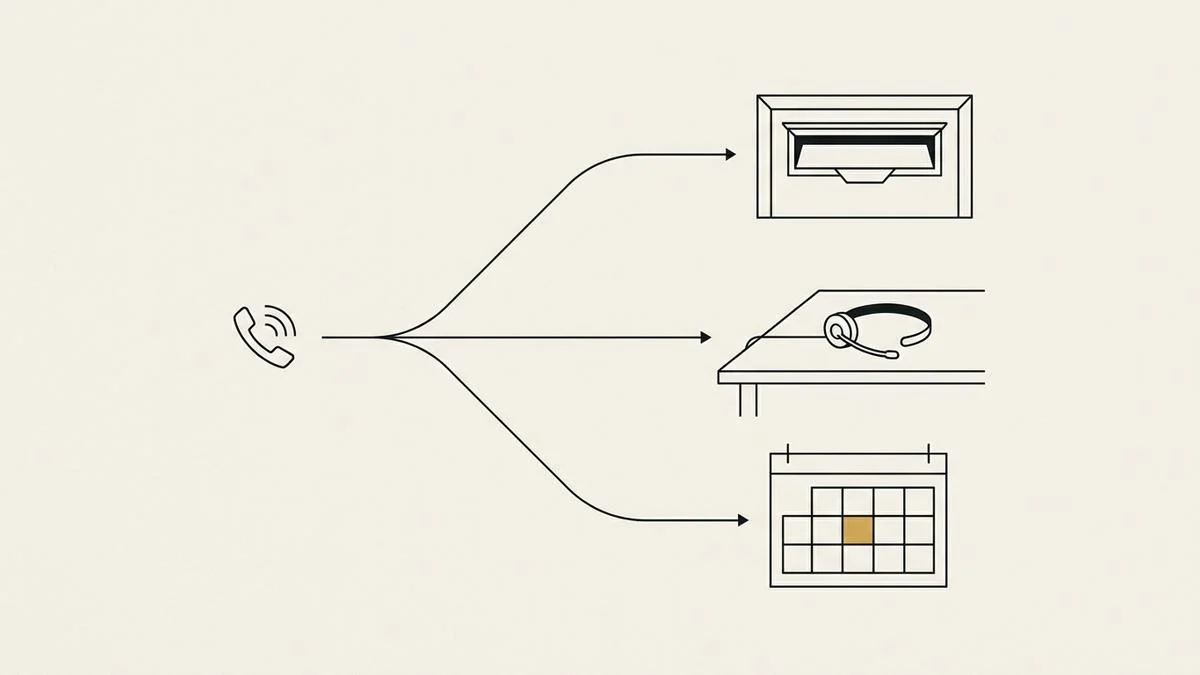
Voicemail records a message and waits for you. An answering service puts a person on the line who takes the message for you. An AI receptionist answers the caller's questions and books the job while the call is still live.
The difference that matters is what you are holding when the call ends: a recording, a written message, or a booked job. This guide walks a single real call through all 3 options, then sets out what each costs and who each one suits.
The short version
- Voicemail costs nothing, but 86% of consumers do not answer calls from numbers they do not recognize (Hiya State of the Call 2026). Your callback often fails.
- A human answering service bills by the minute. AnswerConnect Canada lists 100 minutes for $325 CAD a month, then $2.95 CAD a minute (AnswerConnect, retrieved 2026-10-05).
- An AI receptionist answers every line at once and books into your calendar. Many bill a flat monthly plan.
- People still prefer people: 84.9% of consumers in the US and Canada would rather reach a human agent than an AI one (Metrigy, November 2025 survey). At 8 pm, though, the real alternative is voicemail.
- Pick by your calls. Booking and quote calls favour AI. Upset or unusual callers favour a person.
What each one does with the same call
Each option handles the same call in a different way, and only one ends with a booking. Take a Tuesday at 7:40 pm. A caller asks a mover whether they can do a 2-bedroom move on Saturday, and roughly what it costs.
- Voicemail. The caller hears your greeting and decides whether to leave a name and number. If they do, you call back tomorrow from a number they may not pick up.
- Answering service. A trained person answers in your company name, takes the caller's details, and promises a callback. Some services book into a calendar if you set that up, but they only know your rates if you write them a script.
- AI receptionist. Software answers in your company name and asks about the rooms, the floors, and the date. It gives the price you set for that job, books the slot, and texts you the details.
| Voicemail | Answering service | AI receptionist | |
|---|---|---|---|
| Who answers | Nobody | A person at a call centre | Software that talks |
| Hours covered | None, in practice | The hours you buy | Every hour |
| Calls at once | 1 recording at a time | As many as staff on shift | Every line at once |
| What you get after | A recording, if they left one | A written message | A booked job and a summary |
| Knows your prices | No | Only from a script you write | Yes, from the rates you set |
| Handles an upset caller | No | Yes | Poorly, so it hands off |
| How it bills | Free | Per minute, in bundles | Often flat monthly; check minute caps |
Voicemail is free, and the caller does all the work
Voicemail costs nothing, and it asks the caller to want you enough to wait. A caller who wants a price tonight has every reason to try the next business on the list.
The callback is the weak part. You ring back a number that does not know yours, and most people do not pick up.
86% of consumers do not answer calls from numbers they do not recognize, and only 14% answer immediately (Hiya State of the Call 2026). Censuswide surveyed more than 12,000 consumers in 6 countries, including Canada and the United States.
The same survey asked what single piece of information would make people most likely to answer a business. A verified business name on the caller ID led the list.
If you stay on voicemail, register your business name with your carrier's branded caller ID option. It is the cheapest fix for the callback problem. To see what the misses already cost you, run your own numbers through what a missed call actually costs.
An answering service is people taking messages, billed by the minute
An answering service puts a trained person on your line, and you pay for their time. It is the strongest option on hard calls: a complaint, an emergency, or a caller who needs reassurance. Most plans are minute bundles, so the bill follows your call volume.
These are list prices from each vendor's own page, retrieved 2026-10-05. Check the page again before you sign, because plans change.
| Provider | Plan | Published price | Minutes included |
|---|---|---|---|
| Ruby | Starter | $250 USD a month | 50 |
| Ruby | Popular | $720 USD a month | 200 |
| AnswerConnect Canada | Entry | $325 CAD a month plus $75 CAD setup | 100, then $2.95 CAD a minute |
| AnswerConnect Canada | Growth | $425 CAD a month, no setup fee | 300, then $2.75 CAD a minute |
Read the minutes, not the headline price. AnswerConnect rounds every call up to the nearest minute. If your minutes quadruple in a busy July, the Entry bill more than triples, as the chart shows.
What you get back is a message, not a job. The agent follows a script you write. They can quote from your rates only if you hand them a price sheet.
An AI receptionist answers, quotes, and books on its own
An AI receptionist is software that holds a phone conversation, answers questions, and books the job. It works from your service area, your hours, and your price list. It does not take a message for later; it finishes the call.
It is strongest where an answering service is weakest. It answers every line at once, so 3 callers at 7:40 pm all get through. It quotes from the rates you set and books straight into your calendar.

Many AI plans bill a flat monthly fee rather than by the minute. Goodcall, for example, lists unlimited minutes on each of its per-agent plans (Goodcall, retrieved 2026-10-05). A long call costs the same as a short one, so a busy season does not reprice your month.
It has limits, and you should plan around them. It handles an angry customer poorly and cannot judge a job that needs a site visit to price. A good setup knows when to stop and hand the call, or a text, to you.
Do callers mind talking to an AI receptionist?
Some do. Most people still prefer a person when they have the choice, and the numbers are not close.
84.9% of consumers prefer a human agent over an AI agent, and 80.1% still do when told either one would resolve their issue (Metrigy). Metrigy surveyed 503 adults in the United States and Canada in November 2025.
The same study found acceptance rising. 45.5% of consumers say they use AI in select circumstances, up from 39.2% in 2024 (Metrigy, February 2026).
That preference is about service in general, not about your 7:40 pm call. When you are on a job, the caller's real choice is not AI or a human. It is AI or voicemail, and speed decides it.
83% of US consumers choose the business that responds first to an inquiry (Contracting Business, May 2026). The survey covered 500 construction and building trade companies and 2,000 consumers. Moneypenny, which sells answering services, ran it.
Which one fits your business
Sort last month's calls into 2 piles: callers who wanted a time, a price, or an answer, and callers who needed judgement. The bigger pile picks your option.
- Fewer than 2 missed calls a week, all in business hours: keep voicemail. Set up branded caller ID and call back within the hour.
- Many emergencies, complaints, or sensitive calls: use a human answering service. Budget for your busiest month, not your average one.
- Mostly price and booking calls, plus evenings: use an AI receptionist. It quotes and books while you work, and a flat plan keeps the bill steady.
- A mix: use an AI receptionist for bookings and set it to send hard calls to you or a person.
After-hours volume is real but smaller than the category claims. 14.1% of inbound calls to residential HVAC shops arrived outside business hours in June 2025, falling to 9.8% in October (ServiceTitan, published 3 June 2026). That is HVAC data, so count your own trade before you buy.
Before you choose, compare all 3 against a hire. Our guide to AI phone answering for service businesses sets out what a receptionist on payroll costs.
Where a quoting agent fits
Samro Studios builds quoting agents for service businesses. Ours answers the phone like an AI receptionist, quotes from your rates, and books the job. It texts and emails you the details, in English or French, under your company name.
You can hear a real call on the home page. To get one built around your business, tell us your trade on the contact form. Real builds for other businesses are on the portfolio.
Frequently asked questions
What is the difference between an AI receptionist and an answering service?
An answering service puts a person on your line who takes a message and passes it on. An AI receptionist is software that answers questions, quotes from your rates, and books the job during the call. The service ends with a message for you to act on; the AI ends with a booking.
Is an AI receptionist cheaper than an answering service?
Often, at higher call volumes, when the AI plan bills a flat monthly fee. Human services bill minutes: AnswerConnect Canada charges $2.95 CAD a minute after the first 100 on its Entry plan (AnswerConnect, retrieved 2026-10-05). Compare your busiest month, not your quietest one.
Is voicemail good enough for a small business?
Only if you miss very few calls and return them fast. Your callback struggles, because 86% of consumers do not answer calls from unknown numbers (Hiya, fielded December 2025 to January 2026). Branded caller ID helps.
Can an AI receptionist handle an angry customer?
Not well, and it should not try. AI is strong on routine calls: prices, availability, service area, and bookings. A good setup passes a complaint or an emergency straight to you or a person, details already written down.
Can I use an AI receptionist and an answering service together?
Yes. Let the AI answer every call first and book the routine jobs, then route complaints, emergencies, and unusual jobs to a person. You pay people only for the calls that need one, which keeps the per-minute bill down.
The decision
Count 1 week of missed calls and sort them into bookings and judgement calls. If you miss almost none, keep voicemail and brand your caller ID. If hard calls dominate, a human answering service earns its per-minute price.
If most of your missed calls are people asking for a price or a time, an AI receptionist answers them while you work. Tell us about your trade on the contact form and we will set out what an agent built around your rates would handle.
Sami Bdeira is the founder of Samro Studios, which builds quoting agents and custom tools for service businesses in the United States and Canada.