Google and AI answers
How a local business shows up on Google and in AI answers
Where a local service business shows up on Google and in AI answers, what decides each of those surfaces, and the order to fix them in. No rankings promised.

A local service business shows up in three places: the map results, the blue links under them, and the AI answer above both. All three are fed by the same two assets, a verified Google Business Profile and a website Google can read.
There is no separate AI checklist. Google states it plainly. "There are no additional requirements to appear in AI Overviews or AI Mode, nor other special optimizations necessary" (Google Search Central, retrieved 2026-09-07).
This guide covers what decides each surface, and the order to fix them in. Nobody can promise you a position on any of them, including us.
The short version
- Google says local results are "mainly based on relevance, distance, and popularity," and that "there's no way to request or pay for a better local ranking on Google" (Google Business Profile Help, retrieved 2026-09-07).
- Showing up in AI answers needs no new files, no new markup, and no separate budget (Google Search Central, retrieved 2026-09-07).
- AI Overviews appeared on 15.69% of tracked queries in November 2025, after peaking at 24.61% in July (Semrush, 10 million keywords).
- 78% of Canadian small businesses have a website. Only 52% actively use Google Business Profile or Maps (CFIB, 2,478 owners, September 2025).
- Fix the profile first, the website second, and the reviews continuously. That order is not negotiable.
The three places a customer finds you
A customer searching "emergency plumber near me" on a phone sees up to three results blocks. Each one is decided by different inputs, so knowing which block you are missing tells you which asset is broken.
| Where you show up | What it is | What mainly decides it | Where the work happens |
|---|---|---|---|
| Map results and Google Maps | The boxed set of nearby businesses with ratings and a call button | Relevance, distance, and prominence, per Google | Your Google Business Profile |
| Organic results | The standard links below the map block | Whether a page on your site answers that exact search | Your website |
| AI answers | The written summary above everything, in Google AI Overviews and AI Mode, or in an assistant like ChatGPT | On Google, the pages it already indexes and ranks. In ChatGPT, the pages OpenAI's own crawler can reach | Your website, plus your profile |
Two of the three rows point at your website, and all three point at content you control. Nothing on that table can be bought.
Start with the profile anyway. It is the only asset here that can change a search result inside a week, and it is free.
Your Google Business Profile decides the map results
Google publishes the inputs. Local results are "mainly based on relevance, distance, and popularity" (Google Business Profile Help, retrieved 2026-09-07). The same page then names the third factor "Prominence," so treat the two words as one idea.
Relevance is "how well a Business Profile matches what someone is searching for." Distance is "how far each business is from the customer who's searching." Prominence "means how well-known a business is," and is "based on info like how many websites link to your business and how many reviews you have."
You cannot move distance. You can move relevance and prominence, and both come down to filling the profile out completely. Google says so on the same page: "Businesses with complete and accurate info are more likely to show up in local search results."
That means the boring fields carry the weight:
- Primary category. Pick the one that names what you actually sell, not the broadest one available.
- Service area or address. A business customers visit needs the address. One that drives to customers needs the service area.
- Hours, including holidays. Wrong hours produce a wasted trip and a one-star review.
- Services and descriptions. Every service you would answer the phone about, written out.
- Photos of real work. Not stock, not the logo repeated 12 times.
Verification is the gate before any of it counts. "When you verify your business on Google, you gain ownership of your Business Profile," and "verification review can take up to 5 business days" (Google Business Profile Help, retrieved 2026-09-07). You do not pick the method: it is "automatically determined by Google."
What Google says about showing up in AI answers
Nothing new is required. Google's own documentation states there are "no additional requirements to appear in AI Overviews or AI Mode, nor other special optimizations necessary" (Google Search Central, retrieved 2026-09-07). The same page adds that "you don't need to create new machine readable files, AI text files, or markup," and that there is "no special schema.org structured data that you need to add."
To be quoted in a Google AI answer, a page has to be indexed and eligible to appear in normal search with a snippet. That is the whole technical bar, and it is Google's.
Assistants that run their own crawler set their own bar. OpenAI states that "OAI-SearchBot is used to surface websites in search results in ChatGPT's search features," so check that your robots.txt does not block it (OpenAI, retrieved 2026-09-07).
What has changed on Google is how often the answer appears, and for which searches.
Read the shape, not the endpoints. The rate more than doubled by July, then pulled back, so anyone quoting one fixed percentage is quoting one week.
Who the answer reaches matters more. Over the same period, the share of commercial queries showing an AI Overview grew from 8.15% to 18.57% (Semrush, January to November 2025). Commercial queries have a buyer behind them.
Does answer engine optimization need its own budget?
No. Answer engine optimization, usually shortened to AEO, is the practice of getting named inside an AI answer. It is a label for the same work, not a second discipline with a second invoice.
Google defines both acronyms and then settles the question itself. "From Google Search's perspective, optimizing for generative AI search is optimizing for the search experience, and thus still SEO," as reported by Search Engine Journal, 2026-05-15.
The audience is real, which is why the label keeps selling.
34% of U.S. adults say they have ever used ChatGPT, roughly double the share in summer 2023 (Pew Research Center, survey of 5,123 U.S. adults, fielded February 2025).
So treat any quote that splits "SEO" and "AEO" into two line items as a pricing decision, not a technical one. Ask what the second line item builds that the first does not.
Your website is what Google and the assistant quote
An AI answer can only repeat what it can read on a page. Say "we do plumbing in Ottawa and the surrounding area" and there is nothing specific to quote. Something else gets quoted instead.
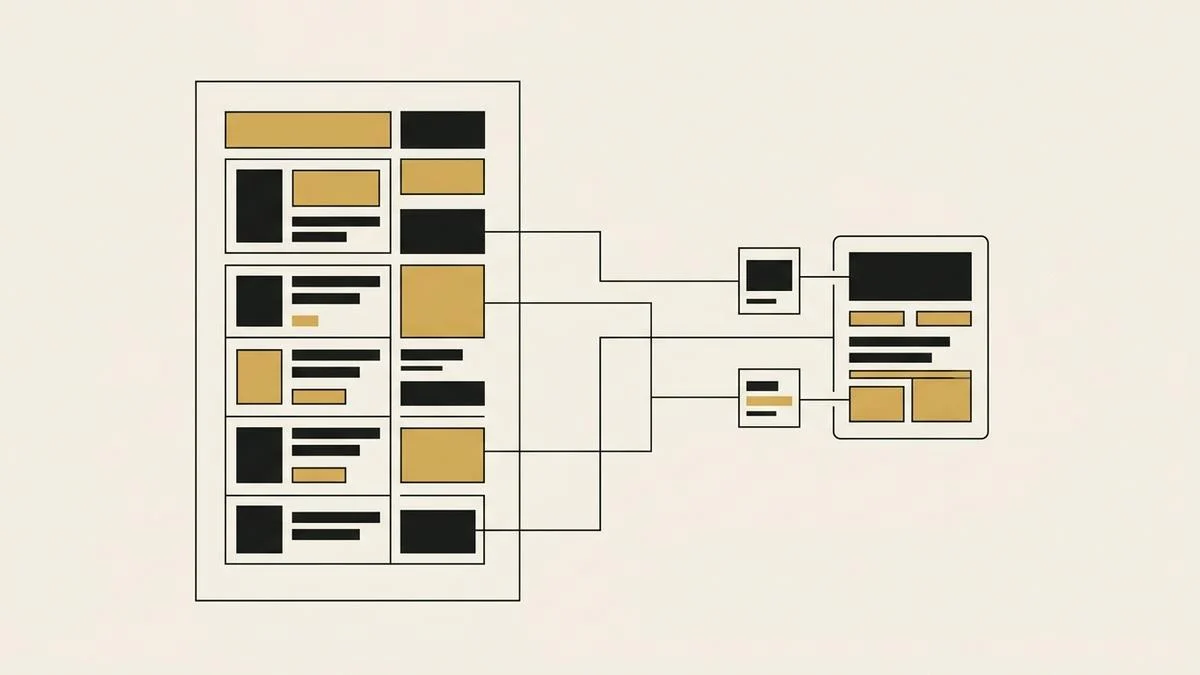
Three things make a page quotable, and none of them are exotic:
- A page per service, per city you serve. One page that answers one search.
- The answer in the first sentence of every section, with the price, the timeline, or the number stated instead of implied.
- Structured data that matches the visible page. Local Business markup lets you "tell Google about business hours, different departments within a business, reviews," and more. It requires two properties,
addressandname(Google Search Central, retrieved 2026-09-07).
Structured data is a translation layer, not a ranking lever. It tells Google what the page already says, in a format it does not have to guess at. Every build in our portfolio is structured that way.
Speed on a phone is a pass or fail number
Core Web Vitals are three thresholds you can test today (web.dev, retrieved 2026-09-07). Largest Contentful Paint "should occur within 2.5 seconds of when the page first starts loading." Interaction to Next Paint should be "200 milliseconds or less."
Cumulative Layout Shift should stay at "0.1 or less." Each is measured at "the 75th percentile of page loads."
Those numbers matter twice. A slow page loses the customer before the form appears, and a page a crawler struggles with is harder to quote.
Run your pages through Google's PageSpeed Insights and read the field data, not the score. On the builds we have taken over, the failures almost always carry a page builder plus a stack of plugins.
Reviews are the fastest thing you can move
Reviews feed prominence, one of the three inputs Google names. They are also the only input that grows while you are on a job, and nearly everyone reads them.
Just 4% of consumers say they "never" read online business reviews (BrightLocal, survey of 1,026 U.S. adult consumers, 2025).
BrightLocal's 2025 trend line shows trust cooling at the same time. It puts the 2020 figure at 79% of consumers trusting reviews as much as personal recommendations. The 2025 figure is 42% (BrightLocal, 2025).
Volume alone stopped being enough. What still works is a steady stream of recent, specific, replied-to reviews, asked for by text the day the job is finished. Never buy them, and never write them.
One page per service, and per city you serve
A single page listing 14 cities does not answer any of the 14 searches. A separate page for each city you genuinely work in does, and it gives the map result something to point at.
Write them properly or not at all. Each page needs its own detail: the neighbourhoods, the drive time, the permit or seasonal quirk, and the jobs you have done there. Duplicated pages with the city name swapped are worth nothing.
Our own city pages are built that way, one per market: Toronto, Montréal, Vancouver, Calgary, Edmonton, Ottawa, Winnipeg, Québec City, Hamilton, and Halifax. The same structure works city by city in the United States.
Two of those markets also ship as French twins, the French Montréal page and the French Québec page. A French page earns French searches an English page cannot.
Where most service businesses actually stand
Most are already half done, which is where the opening is. 78% of Canadian small businesses have a company website. Only 52% actively use Google Business Profile or Maps (CFIB, survey of 2,478 independent business owners, September 2025).
Those are two separate survey totals, so they do not pin down the overlap. They do set a floor: at least 26% of Canadian small businesses have a website and no active profile.
The best US figures are not directly comparable. The shape is familiar to anyone who has searched their own trade in their own city, and in either country the gap those numbers expose is the one to work in.
66% of owners in that same survey say lack of time is their biggest obstacle (CFIB, September 2025). So the plan below is ordered by effect per hour, not by completeness.
What to do first, in order
Start with the profile, because it is the only item here that can change a search result this week.
| Order | What to do | Time it takes | Who can do it |
|---|---|---|---|
| 1 | Claim and verify the Google Business Profile | 30 minutes, plus up to 5 business days of review | You |
| 2 | Fill in category, service area, hours, services, and 10 real photos | 2 hours | You |
| 3 | Set up a review request by text after every finished job | 1 hour to set up | You, or a tool |
| 4 | Test the three Core Web Vitals thresholds on a phone | 10 minutes | You, then a developer if it fails |
| 5 | Build one page per service, per city you serve | 1 to 2 weeks | A developer |
| 6 | Add Local Business structured data that matches those pages | Part of the build | A developer |
Items 1 through 4 are free and yours. Items 5 and 6 are a build, and that is where a proposal comes in.
What this costs
Samro Studios builds these sites as an AI consulting firm, and every project starts with a free AI audit: a 30-minute call, then a written summary of where your site, your Google Business Profile and AI answers stand. What we would build comes back as a written proposal, scoped for one company.
| What you get | How it is priced | Term |
|---|---|---|
| The free AI audit and its written summary | Free | No commitment |
| A custom hand-coded site, with hosting and support | Scoped in the proposal | You approve it before launch |
| Google Business Profile and AI-answer visibility work | Scoped in the proposal, optional | No commitment |
What no one can sell you is a position. Google says it directly: "There's no way to request or pay for a better local ranking on Google."
Verification review of a Google Business Profile "can take up to 5 business days," and the method is "automatically determined by Google" (Google Business Profile Help, retrieved 2026-09-07).
Frequently asked questions
How do I get my business to show up on Google Maps?
Claim and verify your Google Business Profile, then complete every field. Google says local results turn on relevance, distance, and what it calls prominence, and that complete, accurate information makes a profile more likely to show (Google Business Profile Help). Verification review takes up to 5 business days.
Do I need to do anything special to show up in AI answers?
Not on Google. Its documentation says no additional requirements or special optimizations apply, and no new files or markup are needed (Google Search Central). The page has to be indexed and eligible for a normal snippet. ChatGPT crawls separately, so keep OAI-SearchBot unblocked.
Is AEO different from SEO?
Not in practice. AEO, or answer engine optimization, describes getting named inside an AI answer. It comes from the same clear, indexed, well-structured pages that earn ordinary search results. Treat a quote that bills SEO and AEO separately as a pricing choice, not a technical one.
How many Google reviews do I need?
There is no threshold Google publishes, and anyone naming one is guessing. What Google does say is that review count feeds prominence. Aim for a steady flow rather than a burst. Only 4% of consumers never read reviews, and 42% now trust them as much as a personal recommendation (BrightLocal, 2025).
Does a slow website hurt my local visibility?
It hurts the customer first. The published thresholds are 2.5 seconds for Largest Contentful Paint, 200 milliseconds for Interaction to Next Paint, and 0.1 for Cumulative Layout Shift (web.dev). All three are measured at the 75th percentile of page loads.
Do I need a separate page for every city I serve?
Yes, if you genuinely work there and can write something specific about it. One page listing 14 cities answers none of the 14 searches. Duplicated pages with the city name swapped are worse than none, because they give a reader and a crawler nothing new.
The decision
Do the profile this week, yourself, for nothing. It is the only item on this page that can change what a customer sees in days rather than weeks.
Then decide whether the website behind it gives an answer engine anything to quote. If it does not, tell us about the project on the free AI audit request and you get an exact figure back, not a range.
Sami Bdeira is the founder of Samro Studios, an AI consulting firm for established companies in the United States and Canada.